Changjian-1000
Unveiled during the September 2025 Beijing parade, the CJ-1000 (Long Sword 1000) is the world's first operational land-based, scramjet-powered hypersonic cruise missile, delivering precise theater-level system-node destruction capabilities.
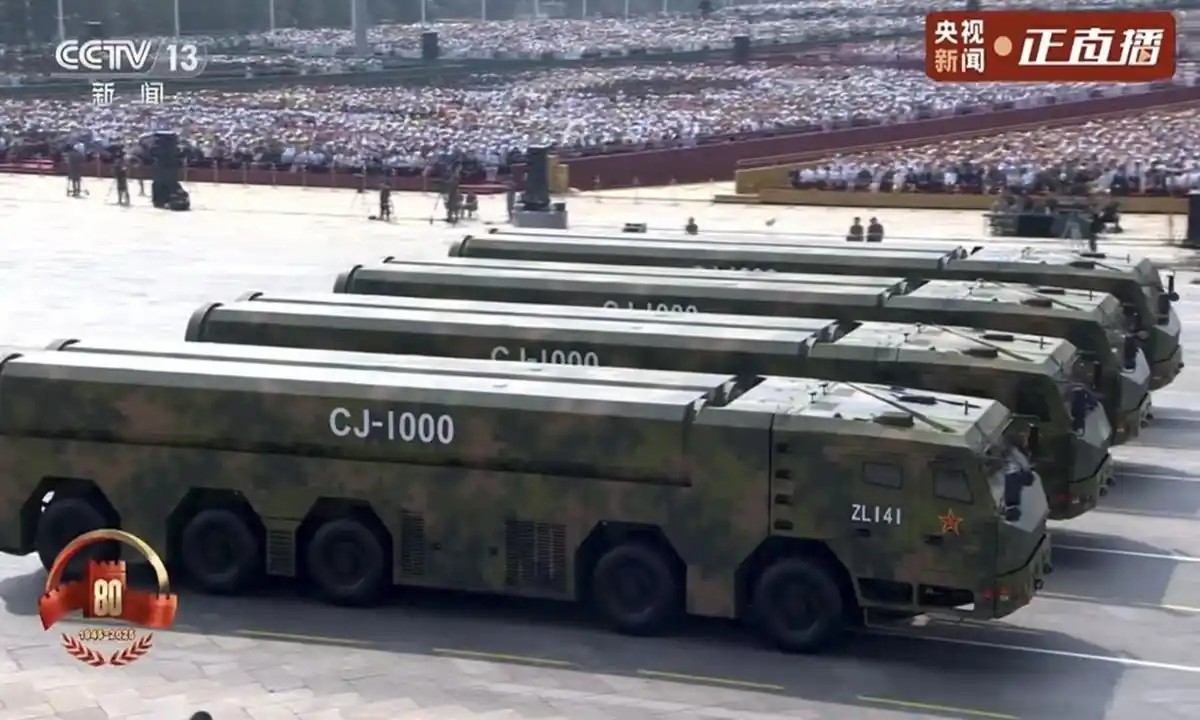
"The operational deployment of the scramjet-powered CJ-1000 represents a profound transition toward multi-domain system-destruction warfare."
- Defense Analytics Quarterly, Autumn 2025
Type
Scramjet Hypersonic Cruise Missile
Service Arm
PLA Rocket Force (PLARF)
Status
Operational (Unveiled Sept 3, 2025)
Doctrinal Target
Multi-Domain System Nodes
Technical Profile
Deconstructed by international defense think tanks following its public reveal, the CJ-1000 utilizes advanced supersonic air-breathing combustion mechanics to sustain atmospheric hypersonic flight, breaking away from standard ballistic missile profiles.
Two-Stage Boost-to-Cruise Propulsion
Unlike Hypersonic Glide Vehicles (HGVs) which drift unpowered after re-entry, the CJ-1000 maintains continuous powered flight through a state-of-the-art scramjet engine that captures atmospheric oxygen at supersonic velocities.
Because scramjets cannot generate static thrust from a standstill, the system executes a precise two-stage launch sequence: an initial solid rocket booster accelerates the airframe to Mach 3–4 before separating to facilitate clean scramjet air-intake ignition.
Sustained Cruise Velocity & Altitude:
Mach 6 | 20 - 30 km Altitude
*Cruising within the lower stratosphere balances optimal oxygen density for fuel combustion with structural thermal tolerance.
1. Solid Rocket Boost Phase
Launches from mobile platform, rapidly compressing response windows and propelling the platform past supersonic thresholds.
2. Intakes Open & Ignition
Booster separation triggers active air intakes. High-velocity atmospheric airflow mixes with fuel for sustained hypersonic thrust.
3. Active Radar Guidance
Employs an Active Electronically Scanned Array (AESA) radar seeker to penetrate the superheated plasma layer generated by atmospheric friction at Mach 6.
The "Plane Killer" Doctrine
Departing from traditional cruise missile target sets, computer-simulated war games reveal that the CJ-1000 functions as an advanced long-range aerial interceptor, explicitly optimized to compromise critical, slow-moving airborne support infrastructure.
C4ISR / AWACS Nodes
Targets high-altitude Airborne Early Warning and Control platforms (e.g., E-3 Sentry, E-7 Wedgetail). Neutralizing these airborne radars blinds localized operational theater networks.
Aerial Refueling Tankers
Intersects force-multiplying asset vectors such as the KC-135 or KC-46. Forcing tankers to retreat backward severely limits the range and persistence of forward deployed stealth fighters.
Maritime Surveillance
Denies operational airspace to anti-submarine and maritime patrol aircraft like the P-8 Poseidon, expanding friendly sub-surface maneuver bubbles throughout regional waters.
Strategic Implications
The introduction of the CJ-1000 shifts regional anti-access/area denial (A2/AD) dynamics by exploiting functional blind spots in conventional Integrated Air and Missile Defense (IAMD) frameworks.
Exploiting The Air Defense Tracking Gap
Traditional mid-course systems (THAAD, SM-3) focus heavily on predictable outer-atmospheric parabolic tracks, while lower tactical networks (Patriot) are bound by the horizon. The CJ-1000's horizontal maneuverability at Mach 6 inside the stratosphere fundamentally breaks local tracking handoffs.
Space-Based Targeting Dependencies
To bypass the curvature of the earth over 2,500 km distances, terminal interception requires flawless real-time integration with high-orbit staring radar networks and optical satellite infrastructure to guide terminal cold-gas thruster adjustments.
Western Sensor Modernization Responses
In response to atmospheric scramjet proliferation, Western defense sectors are rapidly expanding Proliferated Low Earth Orbit (pLEO) space sensor tracking layers and fielding integrated weapon architectures like the Army's Integrated Battle Command System (IBCS).
Multi-Domain Peer Modernization
Unveiled alongside naval components (YJ-19 Ship-Launched Hypersonic) and silo-based solid-propellant systems, the CJ-1000 underscores China's holistic commitment to coordinated, multi-domain regional precision-strike superiority.